
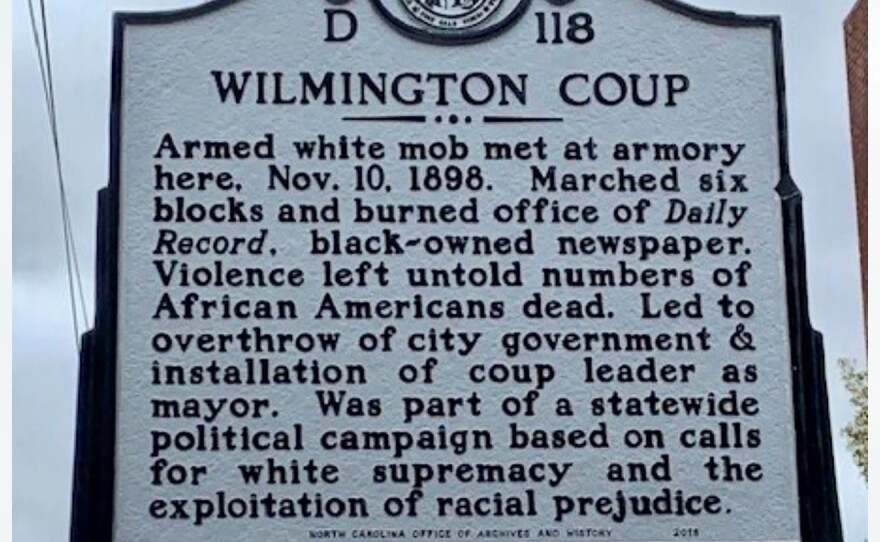
On November 10, 1898, armed White supremacists, organized by members of the local Democratic Party, attacked Wilmington’s Black community and forced its Fusionist, biracial government to resign at gunpoint. A mob burnt down The Daily Record, the only Black-owned daily paper in the country at the time, and opened fire on Black residents with a machine gun and other weapons. The city’s thriving Black middle class was destroyed; an untold number — likely hundreds — were murdered, and many more were driven out of town.
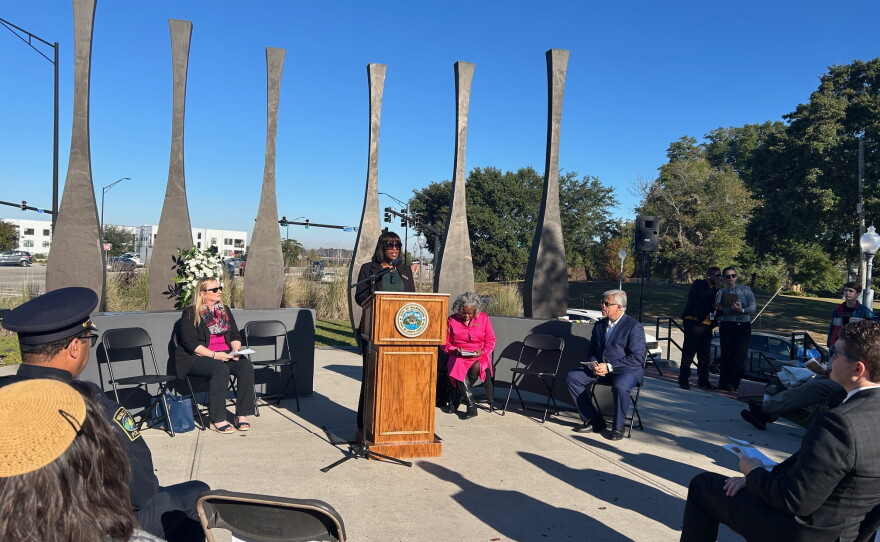
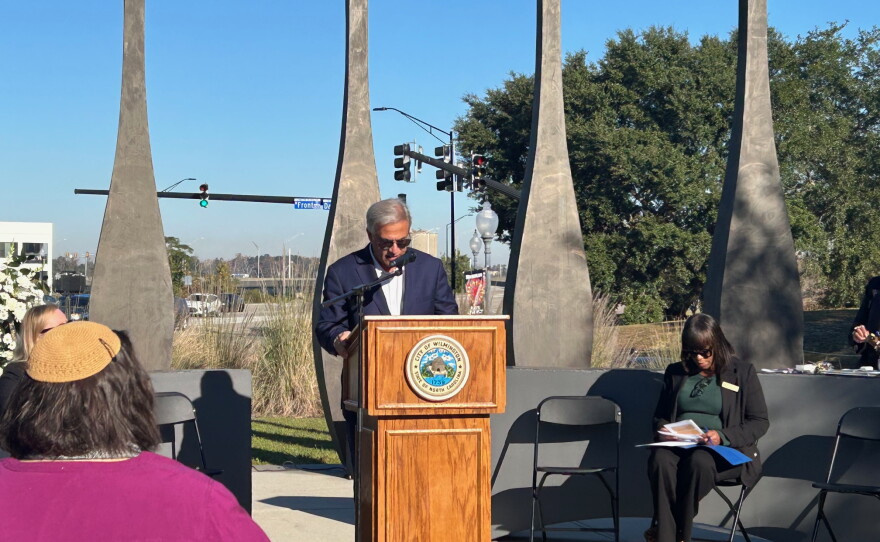
This week’s ceremony, presented by Wilmington’s Commission on African American History and New Hanover County, honored the 128th anniversary and the memory of those who were affected. Local officials and community members gathered near the entrance to downtown on North Third Street at the 1898 Memorial, which was dedicated in 2008.
Mayor Bill Saffo noted the massacre took place on the same date as Kristallnacht, the Nazi pogrom against Jews that took place on the night between November 9 and 10 in 1938, forty years later. Saffo said it was the community’s responsibility to never allow that kind of discrimination or violence again.
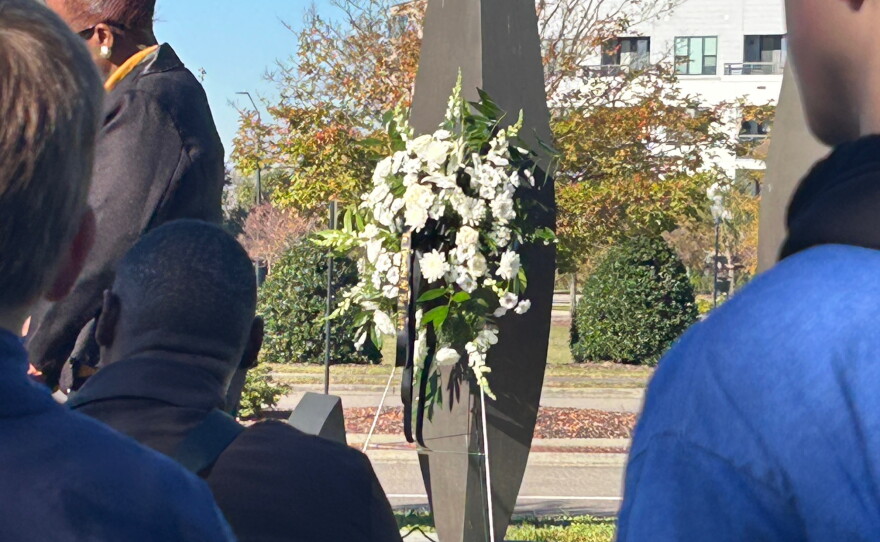
Evelyn Adger, chair of the Commission on African American History, described the wreath’s metaphorical importance.
“The wreath is more than an arrangement of flowers; it is a symbol of remembrance, a symbol of respect, a symbol of the promises that we make to those who came before us. And every flower represents a life worthy of dignity, and every moment of silence represents a story that deserves to be told, and every person gathered represents the possibility that we can choose a different future,” she said.
Adger said it was important to remember the violence and destruction but also the successful Black residents who helped build Wilmington before the coup.
“The people in 1898 left us more than a history of suffering; they left us a history of achievement, a history of resilience, a history of determination, and a reminder that Black Wilmington was never defined solely by what happened to it. It also was defined by what its people had accomplished, what they believed in, and what they had dared to build,” she said.
There were several incidents that increased tensions leading into November of 1898, including a powerful editorial written by Alexander Manly, the Daily Record’s editor and co-owner, which challenged White Supremacists tropes, including those about sexual relationships between Blacks and Whites. However, many historians have seen 1898 more broadly as a violent reaction to the economic and political success of the Fusion movement, a pragmatic coalition of working-class Whites in the Populist Party and both Black and White Republicans. (Notably, while committed to White Supremacy at the time, the Democratic Party would eventually come to support the Civil Rights movement in the mid-20th century, while the Republican Party embraced the ‘Southern Strategy’ to woo racist Southern Whites in the 1960s.)
Though the massacre has been called the nation’s only successful coup, it wasn’t an isolated incident, but part of a campaign of White supremacist terror across the state, as Blacks were gaining increasing political power and economic standing under Reconstruction.
“We must tell the story, too. We must teach our children not only about the violence of 1898, but about the strength, the intelligence, the leadership, and accomplishment of the Black community that existed before it. Because our children deserve to know that they come from more than struggle. They come from builders. They come from visionaries. They come from people who understand the value of education, ownership, community, and opportunity. And when they walk through the streets of Wilmington, they should know their history is woven into the very foundation of this city,” Adger said.
She also said that it was only through confronting painful truths that the city would continue to move forward.
The massacre and coup were planned by members of Wilmington’s elite, known as the Secret Nine, including families that would go on to play powerful roles in the region’s development. It also involved a paramilitary group known as the Red Shirts and the Wilmington Light Infantry. But while 1898 was a matter of public record, public conversation about it was uncommon or muted for the century that followed. Some accounts attempted to minimize the violence, or frame the events as a spontaneous outburst, a ‘race riot,’ as opposed to a premeditated act of domestic terrorism. Over the last twenty years, a series of fuller accounts have put the events of 1898 in a fuller, more honest context.
“Let November 10th be more than a day on our calendar. Let it be a day that reminds us that our responsibility to one another, a day when we remember that progress requires participation, that justice requires courage, that healing requires honesty, and that a community's greatest strength is found not in its ability to hide in its painful history, but in its willingness to confront that history and learn from it," Adger said.
Resources:
- How white supremacists staged the only successful coup in U.S. history, CBS This Morning
- Echoes of a Coup: Michael Betts and John Biewen tackle the 1898 massacre in a new Scene on Radio series, WHQR's The Newsroom
- McKinley's Guns, IMDB
- "America's only coup, then what?" A conversation with author Lauren Collins (The Newsroom)
- CoastLine: Fear-based political agenda led to 1898 Wilmington massacre, says LeRae Umfleet
