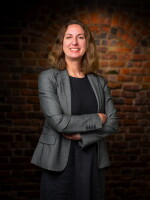
Daniela Williams is a licensed mental health counselor in Wilmington. In her practice, she serves all people but focuses on the wellness of Black mothers.
“For the most part, I'm advocating for people who are underserved, who are not seen, who are voiceless in these systems,” she told WHQR.
And Williams has her own birthing story to share. She said when she went to the hospital in 2017, she wasn’t listened to on several occasions, like when she asked for a binder to help support her stomach after having a C-section. She also said she was accused of not feeding her baby on schedule.
After these incidents, she went home after a couple of days in the hospital.
“I was having headaches that I hadn't had during my entire pregnancy. [...] My hands started swelling, my feet were swelling, my legs were swelling, and you can easily dismiss that as, ‘Oh, you just gave birth,’ but I did not have any swelling throughout my entire pregnancy," she said.
Her blood pressure was also elevated, so Williams returned to the hospital and said she was treated differently, getting less attention, until she told staff that she did have insurance.
“I'm furious, because what if I didn't have insurance? What would have happened to me? And so the medical doctor comes in, and she also kind of dismisses what's happening,” she said.
However, Williams said, luckily, her maternal-fetal medicine doctor was on staff that night.
“She was heading home, and so she was just checking before she left, and she saw my name, and she immediately came in. She said, ‘Hey, what's going on? I explained, care changed. I got medication. I was immediately taken care of. I was placed overnight, watched, and given everything I needed. Because this woman, who happened to also be a Black provider, was there. What would have happened to me had she not been there? And I don't know," she said.
Dr. Kaytura Felix is a Distinguished Fellow at the Bloomberg School of Public Health at Johns Hopkins University. She knows this kind of story well — and has recently conducted a qualitative study on midwives in five cities across the U.S.
“Trust is everything. It's first, it's second, it's third, it's everything. It's what set the foundation for these relationships,” she said.
The stakes are high during birth, especially for Black women, but Felix said it shouldn’t be.
Related: The racial divide in New Hanover County on maternal and infant health statistics
“We know there's research that shows 80% of women and birthing people, women who die from pregnancy are preventable, so that's a tragedy,” Felix added.
Those deaths are from complications like preeclampsia, cardiomyopathy, or incorrect medications.
“All of us have heard about the negative statistics. And the question was, what is the Black community doing about those statistics? And I was told, ‘Look to community midwives,’” she said.
Felix said the research shows that Black women who have access to midwife care have better birthing outcomes, adding that midwives will spend much more time with expecting mothers compared to a shorter checkup with a doctor.
“One of the things we heard from the people we talked to is that the 15-minute meeting is not conducive to having conversations about women's concerns,” she said.
It again goes back to trust — and to the idea that these providers are competent and caring. Felix said that any mom has to have both.
“If your provider does not care for you, you've got to find another provider, and I'm very serious about that, because if your provider is not on your team and does not care for you, chances are they won't be looking out for you. They won't listen to you. They won't respect you, all the things that are needed so that you have a safe delivery,” she said.
And if they don’t receive this type of care, many women will start finding their information online, Felix said. Sometimes, those women can find a valuable sense of community.
“The clients that I interviewed talked about going online when they just felt like their provider wasn’t listening to them, when they couldn't trust their provider. So they went online to really find connection, find affirmation for what they were experiencing,” Felix added.
At the same time, there is a lot of medical misinformation online, and women need to use discretion — and trusted sources — when looking for help.
And while Felix said midwifery should be the standard of practice, as in many other countries around the world, insurance remains a challenge.
“Many of these people have to go out of pocket, paying $4,000-$8,000 to cover that midwife. But many of them felt it was worth it to be treated with compassion, to be treated with respect, to be treated with dignity, so that they could have a safe birth, so that they could have a birth that did not include a lot of trauma that made it worth it,” she said.
Kim Smith is the founder and CEO of Health Evolve Technologies and has spent over 18 years in hospital and medical group administration. Smith’s new company has created a software application to help mainly Black and Hispanic women access care in rural areas.
“My personal drive was really also sparked by the loss of my daughter, Lauren Kelly, 14 years ago, so it was March of 2012 that I was pregnant with my first daughter, and unfortunately, she did not make it. I experienced a severe version of preeclampsia, in a way, it's called HELLP Syndrome, and at 29 years old, I could have had a stroke and not been here. So, after losing her, I really worked to become more of an advocate, and I did that for 10 to 11 years, serving on national board roles with the Preeclampsia Foundation," she told WHQR.
Smith said she wanted to do something different in a system that she views as broken.
“We have so many maternal care deserts. There are so many cases where you may have to drive 45 minutes to get to your prenatal visit, and hopefully you have a car or gas for the ride, so you could spend three hours for that day, trying to do a regular checkup,” she said.
And Smith agrees with Felix, the outcomes for Black birthing in America are not the best.
“The US is one of the wealthiest nations in the world, but we really have, in comparison to other developed nations, the worst maternal mortality rate. So even though we're seeing some incremental improvements, we're still nowhere near where we need to be for Black women. We are three to four times more likely to die from pregnancy, regardless of income or education,” Smith said.
And, according to Smith, it's becoming common knowledge that 80% of health differences are driven by non-medical factors such as community health, safety, and security.
“80%, that's a big number, and part of that has to do with where you live. There's a lot of rich research on how your zip code is more powerful than your genetic code,” she said.
Smith’s application is called Lauren, and she recently launched Lauren 2.0, which has about 350 clients across several states, including North Carolina.
“We have what we call smart learning paths, so they receive AI-enabled micro education based on what's happening in their bodies at the right time; they have access to resources, and that connects them with a human. We don't have AI agents built in. It connects them with a human being because [we] recognize the complexities of addressing maternal health,” Smith said.
Those human beings are community health workers or other members of community-based organizations who can help these women during their pregnancies.
“We found that in our initial deployment of Lauren, the blood pressure rates are very high, and it takes more than just a few months to improve those outcomes. We found that our low birth weight babies are still high in these specific rural areas, and it takes more than just a few months using a digital tool to shift the curve,” Smith said.
When there isn’t a doula, midwife, or community health care worker, Smith’s platform can connect the person to their company’s certified health specialist.
In terms of the financial support needed for Health Evolve Technologies, Smith said that, “with our nonprofits, for example, typically, they would find funding through some type of grant, and they hire us as a technology partner. For our health plan partners, those are from direct contracts with [those] plans. So think of a per-patient, per-month model with them, more of a risk-based model, so we're not, right now, at least needing to drop bills for this. Some states are looking to create reimbursement models for things like blood pressure cuffs, and some of this [remote patient monitoring] billing, but they're still not quite there.”
Williams, like Felix and Smith, tells women, particularly Black women, that, although it’s hard, they shouldn't give up on finding support.
“Your voice matters. Just because one person isn't listening doesn't mean that you have to shut yourself down. There are other people who will listen,” Williams said.
That could be a midwife, a counselor, another physician, or an online application in concert with a community health worker.
Editor's Note: Kim Smith added that Lauren was "not just designed for black women. In fact, most of our current Lauren members are Hispanic today. But we certainly built it based on the disparities of black women."