

Living Hope started as a street ministry in 2020, husband-and-wife founders Tony and Christine Perez moved into a facility at the First Baptist Church in 2023. The following year, they received a $200,000 grant from The Endowment. Over the past several years, downtown stakeholders, including the Wilmington Police Department, have given the organization positive feedback.
When Living Hope needed a new location this year, it ran into concerns from potential neighbors during a community meeting. Issues included whether the day shelter had the proper zoning designation, safety precautions set up, and if people visiting the shelter would be managed properly given the proximity to homes and three schools: New Hanover High, Williston Middle, and the International School at Gregory.
In a Facebook post, Living Hope acknowledged that things could’ve been done better. That said, though a lot of neighbors sounded off against the day shelter opening up near them, many of them are not against day shelters as a concept.
Rather, for many neighbors it was the lack of trust and preparedness on Living Hope’s part that fueled much of their frustration, as Michael Jenkins, a resident of the neighborhood who attended last month’s meeting, explains:
“I reached out to them several times about this to a point of offering before the meeting to walk through the neighborhood with them… Let folks know what their plans were, when the meeting was, how they could add input, and that was consistently declined.”
What struck him particularly was the lack of notice given to many of the Black residents who’ve lived in that neighborhood for generations that Living Hope had their eye on the former Sorrow Drowner.

Welcome to the neighborhood
When Jenkins presented the same offer to walk through the neighborhood to me, I took him up on it.
One of the many people we met was a neighbor who goes by Mississippi. Jenkins and I spoke with her, and she wasn’t in support of the shelter opening.
“A lot of time I see why you homeless people be doing other places around here, you know, do it with trash and you know saying it's just bad and just sit on people's porch and stuff like that. So you know, I don't think [it would] be a good idea,” Mississippi said.
“The thing I would add to that is we don't have very many problems in the neighborhood right now, but we still get walkthroughs," Jenkins said. "So you'll occasionally run to somebody who's passing through from further down that way or further up that way."
"I think personally, you have to be understanding if somebody needs to get out of the sun for a bit or out of the rain, that's one thing," he said. "But I know people on my block have had occasional issues with houses that have stayed empty for longer, where somebody would just move onto the porch for a week. And again, you want to be sensitive to the fact that everybody has to live somewhere.”
Charles Singleton is a senior in the community; he has a soft spot for people around his age who are experiencing homelessness, so he’d be happy if a shelter opened up where they live.
"It's good to have a try to get a place where they can live because you don't know how they're living. Half of them living in the street," Singleton said.
"It's a nice area, but the idea, when you close your door at night, you don't know who is who. That's my concern," he said.
His next-door neighbor Susan agrees that people need somewhere to go, especially as access to public spaces dwindles for the unhoused.
“I think it's a needed service, and if what I was told, I was told that it would be a place for them to be in the daytime. Obviously, they're going to come at night too," she said. "I think that's a lot of people's concerns, but they need somewhere to go during the day. I think it's a good service.”
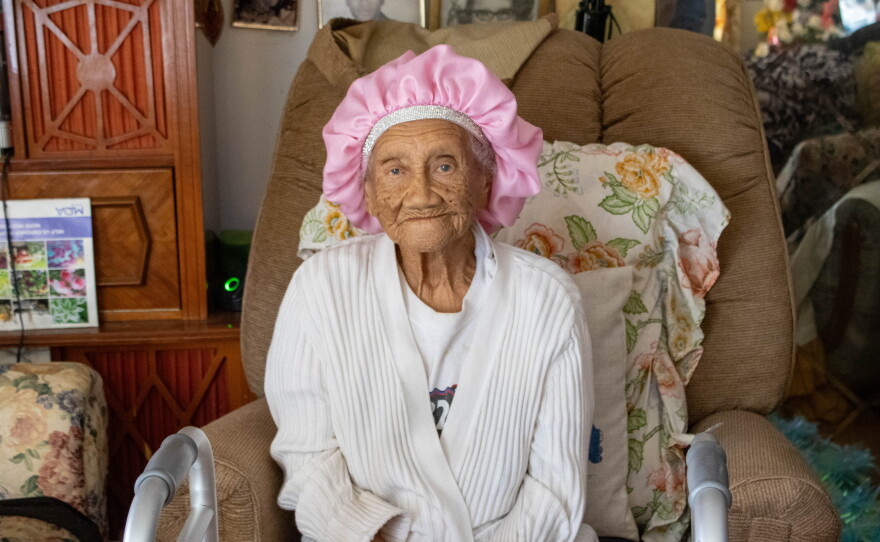
Then there is Rosa Shannon, who’s been living in the neighborhood for 60 years; she’s now 100 years old.
Her daughter Rosa Shannon Durant, spoke on her behalf after hearing about the proposed plans for the shelter for the first time, referencing a shelter in her new hometown of Fayetteville.
“We have that in Fayetteville. Yeah. So far, it seems to be a 100% helping,” Durant said.
“See, in Fayetteville, it's not by school or anything, because that was our biggest concern was school. But they did not put it around no schools or nothing," Durant said. "So now, we see a 100% turnaround, a humongous participation. Like I said, we haven't had no trouble from the homeless either.”
She says she personally isn’t against the idea of a shelter moving in, though she would want to make sure the overgrowth of bushes behind her mom’s home was cleared if one were to open up — though she said she thought that’s probably the city’s responsibility.
Durant says the shelter in Fayetteville is a success now, because concerns like that were heard and addressed, but, “you can't guarantee that nothing ain't gonna happen because you don't know that," she said.
Crime reports
Concerns about crime and other issues were consistently raised by people in the neighborhood. One resident reached out to WHQR, requesting not to be named to protect their privacy. In an email, they wrote:
“The additional pedestrian activity, queuing, and outdoor gathering associated with this use could create congestion and safety concerns along a corridor used daily by neighborhood residents and schoolchildren.”
This neighbor also brought to our attention the number of crimes reported at the day shelter’s previous location at 411 Market Street.
They shared files from New Hanover County’s 911 Center’s Computer-Aided Dispatch system, or CAD files, showing a total of 192 incidents that the Wilmington Police Department responded to since Living Hope began operating at First Baptist on June 1, 2023. They said in the approximately four months prior to Living Hope running out of First Baptist, only 13 events were reported.
This neighbor noted that only five events out of the 192 included in this list of reports had redacted dates.
The source notes that there was a striking concentration of calls on days the shelter was open. They found that, out of the 187 events with visible dates, 146, or about 78%, occurred during Living Hope’s operating days on Mondays and Wednesdays, from 9 a.m. to 1 p.m.
WHQR verified these files with county staff, and after reviewing the files myself, I noticed that while only a handful of reports had the dates redacted, 99 out of 192 items included in this list had the criminal nature of the report redacted.
If you add the five events with both the date and incident details redacted, that leaves about 88 incidents that you can actually argue may be tied to the presence of a day shelter.
Also, out of the 99 redacted events, 80 fell under the Wilmington Fire Department’s jurisdiction. So a significant portion of these calls may not be crime-related at all.
Don’t get me wrong, there were a number of calls WPD responded to at First Baptist Church while Living Hope was there, including some thefts, verbal disturbances, and reports of open drug use.
One incident report from Wednesday, May 14, of last year, detailed a simple assault of a 47-year-old man who was threatened by someone with a knife near church grounds that afternoon. That aligns with the hours of the day the shelter was open.
Also, a 50-year-old resident reported an aggravated assault that appears to have occurred on a Monday, but was reported on a Tuesday. There was also a forcible rape reported on October 9, last year, which was a Thursday — a day the shelter wouldn’t have been open, but still worth noting to show that serious crimes happened in the area on days the shelter was closed.
The identity of the victim was kept off the record, but according to the report, this incident took place at a park or playground at or near First Baptist Church.
Learning to Adapt
A local business owner of a community corner store shared the same concerns over safety as many residents. The owner, who asked not to be named, said he would adapt to the shelter either way.
Over the years, this wouldn’t be the first thing he and the long-time residents have had to adapt to.
“They're doing a lot of reconstruction. I'm gonna use that word instead of the other word people use, 'gentrification,'" he said. "They didn't do their homework, people that's reconstructing the community, they feel like their purpose is being overlooked.”
“I'm not for or against it because I consider myself no better than no one, and I'll adapt whichever way I adapt to it," he said.
He said that the folks at Living Hope actually did inform them of their plans at first, but they should've done more work to include residents in their plans from the start; adding that we live in a society where more and more people are stuck in their own bubble — something, perhaps ironically, that Tony Perez said during the community meeting.
That community connection is one of the things that made Living Hope a great place for people rebuilding their foundation, said Pastor Meg McBride of Hope Recovery Faith Community and Director of the Warming Shelter, which opens when the temperatures drop below 30 degrees for two consecutive nights and daytime temps stay low.
“The day center is definitely very much needed, or a day space where unsheltered people can go," McBride said. "I think the most important thing is for rest, but also to access services like a bathroom, food, right? Coffee. Everyone loves coffee, coats, and personal care items. Women who need tampons and pads.”
For about a year now, McBride has also been sitting at the helm of the news publication The Real Homeless Herald of ILM, along with reporter Theresa Shively, who we’ve featured in some of our past reporting.
The Real Homeless Herald started at Living Hope Day Center when it was housed at First Baptist Church; Shively said they’ve now moved to Grace United Methodist Church.
The mission of the paper is to share the perspectives of people surviving homelessness and foster compassion for their humanity. I would be remiss not to abide by their motto “nothing about us, without us.”
Reporters Theresa Shively and Sebastien Enriquez of The Real Homeless Herald of ILM — people with lived experience of being homeless — told me that while these reports may point to a concentration of crime, the solution isn’t criminalizing them and making resources like the day shelter harder to access.
But Shively said it’s likely pushback will come no matter what location is chosen.
“It doesn't matter who, where, where it's located. Somebody is always going to complain because a lot of people consider homeless, disgusting, trashy, drug addicts. But that's not true," Shively said. "That is not true at all. There are families out there, and a lot of them need this center to help get housing.”
She added that having increased interactions with law enforcement when many unhoused people experience mental health challenges and substance abuse disorder can result in the over-criminalization of people who need help.
Enriquez used to volunteer at Living Hope before the church shut down for renovations, so he understands the tough position the nonprofit is in.
“They do a lot. They try to help with some housing if they can. Even when you need work, you need an ID. That's why before anything, they help you get an ID, then they help you with housing,” Enriquez said.
He agrees with his colleague Shively. However, after hearing residents’ complaints, he understands where they’re coming from too.
“Yeah, it is a tough situation. So the location, the building they were getting, I mean, it's a nice building. Don't get me don't get me wrong. But at the same time, it's in a school zone, it's understandable how how how the people would react,” he said.
On the other hand, as a person with lived experience of being unhoused, Enriquez said day shelters add a certain level of protection, as well.
At the old location, there were at least peace monitors on site.
“That's that part. Tony has got down. Then if [we] want cameras, security cameras,” he said.
He hopes when Living Hope finds a new location that they’ll still have that volunteer support along with security cameras for everyone’s safety.
WHQR requested a conversation with the Living Hope team; however, they declined that request. Co-founder Tony Perez did post about his organization’s recent experiences on Facebook, writing:
“What we did not fully understand at the time was the larger community surrounding that building. We have learned from this experience. We believe effective leadership means being willing to receive new information, evaluate it honestly, and, when necessary, have the courage to change direction.”
No heroes or villains

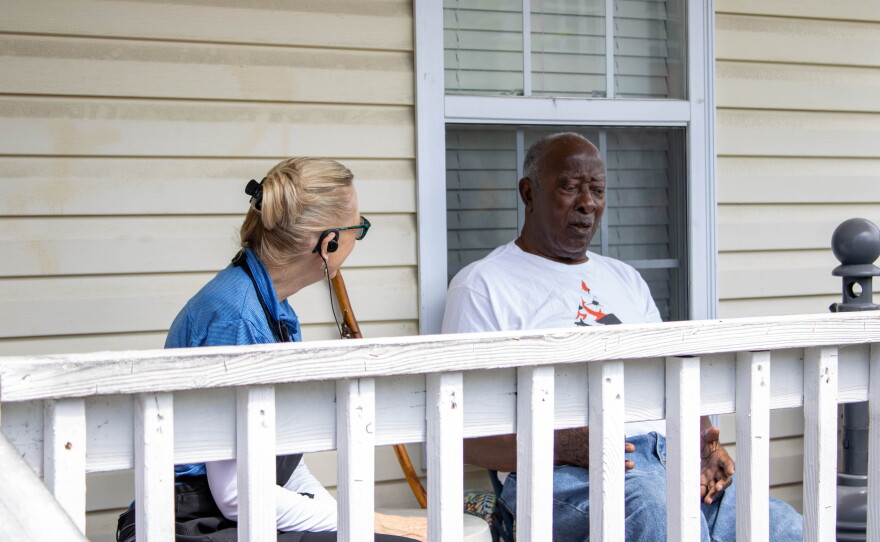
As my neighborhood tour with Michael Jenkins wrapped, he helped me realize that this community is not a monolith — while many seem staunchly opposed to the day shelter opening, there were many who were in support of it.
"And the thing I've learned, and I'm sure you've noticed this. Everybody's life is interesting. Everybody really is the hero of their own story," Jenkins said.
"I don't think this is a heroes and villains kind of situation," he added. "I think this is a how do we do the best thing we can for the community as a whole situation, and I think that's going to take everybody working together in various ways. And I think open communication and honesty are going to be a big part of that."
