

As the sun set on the town of Danbury, a chorus of voices rose in front of the Stokes County Government Center. Amid clapping and whistling, a crowd of about 100 people chanted "no data centers, no data centers" during the January meeting. A projector lit up the right side of the building, displaying a livestream of the county commission meeting that was being held inside.
Stokes County resident Robert Spong stood outside the government building. He shouldered a sign with the same message.
"I think since they had the one spill in the Dan River before with the coal ash, there's a lot of concern that this data center could, for whatever reason, discharge back into the Dan River," said Spong, referring to a 2014 incident when 39,000 tons of coal ash, a toxic byproduct of burning coal, spilled into the Dan River. The pollution came from a coal plant operated by Duke Energy.
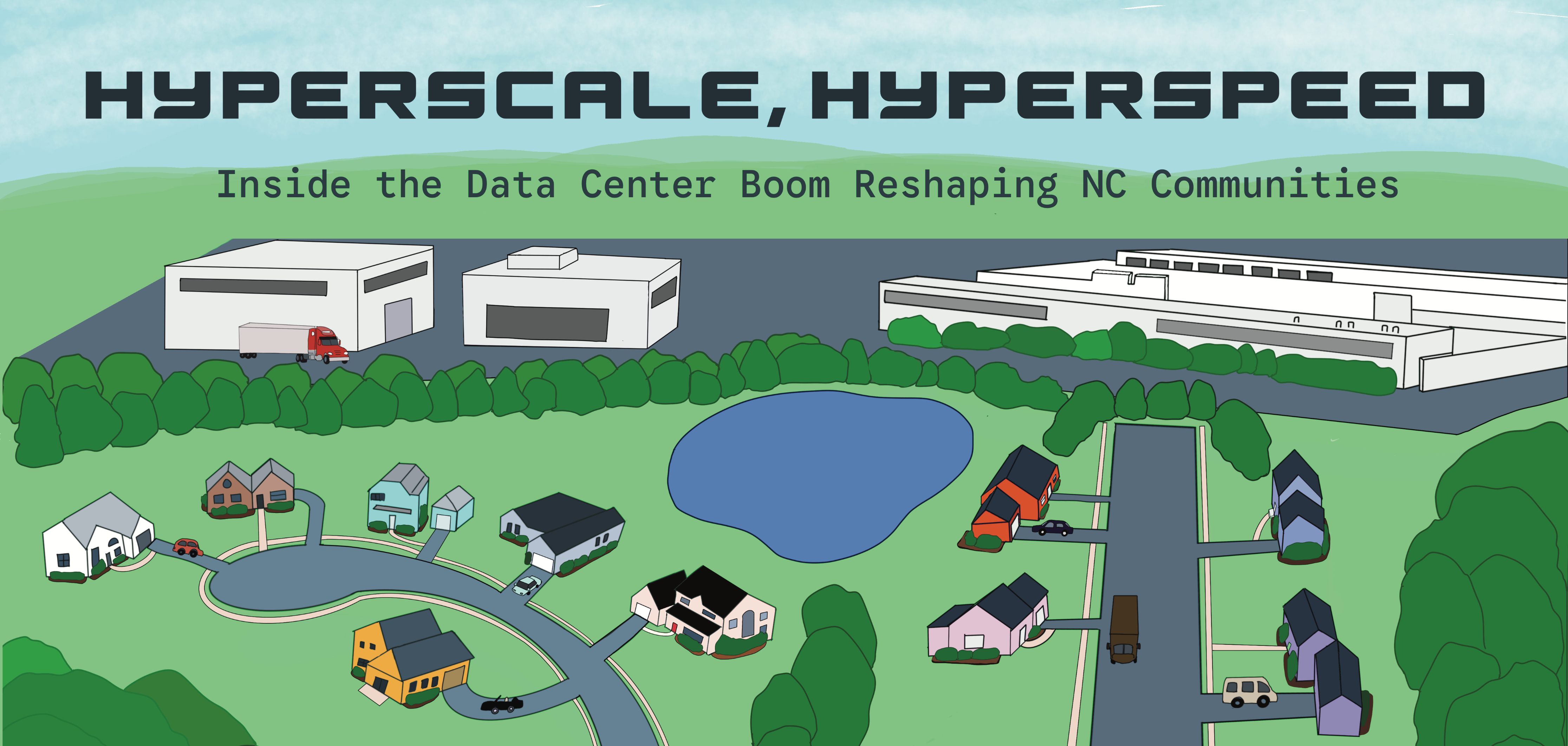
In this 6-part series, BPR, the NC Newsroom, WFAE, and WUNC explore North Carolina's accelerating data-center boom and its real impact on local communities.
Through on-the-ground reporting, document reviews, and conversations with residents, the series examines how Big Tech is reshaping small towns, consuming vast amounts of power, and striking deals that aren't always clear. It explores who benefits, who bears the cost, and why North Carolina has become an appealing target for server farms despite modest public scrutiny. By following the money, the energy demands, and the promises made to communities, the project aims to reveal what's at stake as the cloud moves into the state’s backroads.
About 75 miles south, similar signs filled the Rowan County Courthouse during a utility commission proceeding in March. The hearing wasn't about data centers — Duke Energy was requesting permission from state regulators to build new natural gas generators at its Buck Steam Station. But residents had recently learned about a land deal involving a company linked to data center development.
"We (want to) know how come you guys are … asking us to pay for … that plant up there to power the AI data center that none of us want," Salisbury resident Salvatore Cerbone said.
Across North Carolina, and the country, people are having difficult conversations about how hyperscale data centers are transforming communities. These massive computing facilities power artificial intelligence and cloud storage services – and they bring with them political, environmental and economic implications.
Not all data centers are created equal
North Carolina is no stranger to data centers. There are about 100 in the state that account for up to 3% of the state's energy demand. That demand is expected to more than double by 2030, as the market for larger facilities grows to accommodate these rapidly evolving technologies, according to data from the Electric Power Research Institute.
"(Up until now) most of the new data centers (were) built … for storing grandma's pictures at some level," said Rob Cox, a UNC Charlotte energy expert. "It's just beginning now to shift into that AI phase."
Some communities have enjoyed a positive relationship with local data centers. Forest City Town Manager Janet Mason said Meta, which opened one there in 2012, has been an excellent neighbor.
"When Hurricane Helene hit, not only did they give supplies, but their people showed up to help, to volunteer (and) to distribute supplies," Mason said.
After its initial construction, the data center didn't offer a lot of jobs, but it also didn't bring many of the negatives people have come to associate with these facilities.
"We were shocked at how little water they used, because I think we were hoping to sell a little bit more water to them," Mason said with a chuckle.
But not all data centers are created equal. In 2024, Meta's Forest City facility used 30 megawatts of energy and consumed about 4 million gallons of water. By comparison, one proposed hyperscale project in Edgecombe County is slated to consume 900 megawatts - 30 times that much energy.

Hyperscale, hyperspeed
Some big tech companies are building hyperscale facilities to support their own services, while other businesses are building data centers to lease out.
The tricky part is these developers want to build these hyperscale projects at hyperspeed.
"It's difficult to forecast the load growth, because they might have put an application in in North Carolina and Texas and Georgia, and they're going to see which one gives them power fastest," Cox said.

To fast-track this, utilities like Duke Energy are falling back on fossil fuels at a time when North Carolina is not on track to meet its 2050 carbon neutrality goal, according to the state's most recent greenhouse gas inventory.
Not only that, but climate change is putting a strain on water resources. Corey Davis, assistant state climatologist at the North Carolina State Climate Office, said the state is already seeing the impacts of climate change with unpredictable rainfall.
"The wet periods tend to mean literally when it rains, it pours," Davis said. "You're getting very heavy rain amounts in a very short time period. And then in between those heavy rain periods, it's getting drier faster."
Davis said this environmental uncertainty is another factor communities have to consider when thinking about data centers moving in.
