

This is the latest installment in our Main Street NC series from the WUNC Politics Podcast. We're visiting communities across the state to hear from local leaders about the issues and challenges they’re facing, from beach erosion to healthcare access.
There's not any beach left in front of the Outer Banks Motel, a 70-year-old lodging establishment in Buxton on Hatteras Island.
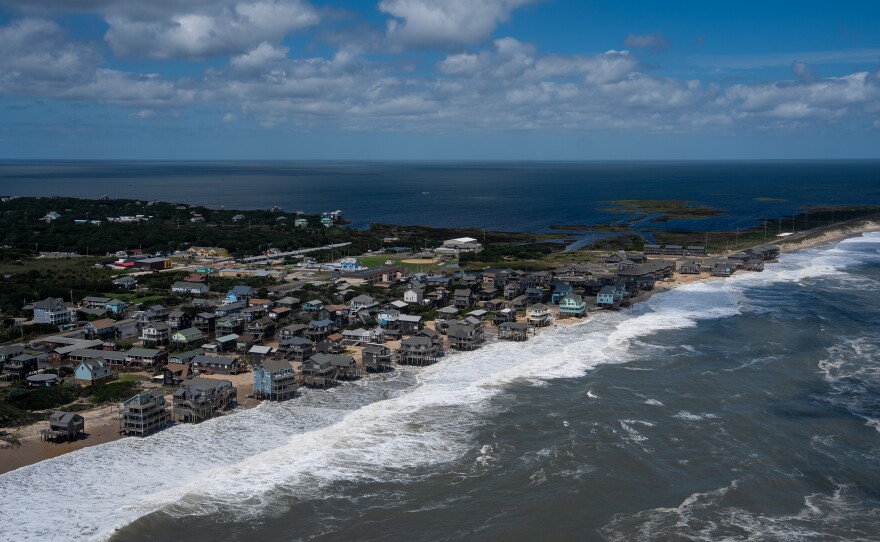
Waves crash directly onto piles of sandbags that are protecting the motel buildings from meeting the same fate as their neighbors a few blocks south. About 20 oceanfront houses in Buxton have collapsed into the ocean since last fall, victims of North Carolina's most severe beach erosion.
Billy Dillon operates the motel with his 97-year-old mother Carol, who's owned it since it first opened in 1955. He says it's getting harder to fight off the Atlantic Ocean from overtaking the property.
"It's very expensive," Billy Dillon said. "I think we probably spent over $100,000 just last spring, and we need more (sandbags) just to protect the property. Because if we didn't have the sandbags, there's nothing to stop it."
Dillon says his motel buildings are also protecting N.C. 12, the highway that connects the Outer Banks. During storms and extreme high tides, ocean overwash floods the road in front of the motel.


Despite a major beach renourishment project here in 2022, there was hardly any beach to sit on in front of the motel's outer buildings in January. The Dillons are still working to repair broken stairs and walkways from last year's storms. Billy says the shifting sands of Hatteras Island are a constant battle.
"Erosion has always been an issue, as long as I can remember," he said. "I wasn't here in the '50s and '60s, but they talked like there was 500 feet of beach then. I've never seen it that big. I remember when I was little, though, you would burn the bottoms of your feet walking into the water – that's how much beach you had to go through. Now there's no beach."
The erosion is even worse farther south on Buxton's oceanfront. Several homes there remain in the water even at low tide. Their utilities have been disconnected, and it's likely too late to move them back away from the water.
Just a few days after WUNC News visited Buxton in January, several of the most endangered homes fell into the ocean during a relatively routine winter storm.
Why have so many homes fallen in such a short time?
Buxton residents say the rapid erosion began at a former Navy facility used during the Cold War to monitor submarines. The Navy built three jetties to protect the site, but they weren't maintained after the Navy left in the 1980s. As the jetties deteriorated, beach erosion exposed some underground fuel storage tanks and leaked contamination into the sand and water.
When the contamination was discovered in 2023, the Army Corps of Engineers closed the beach access and began a clean-up process that's still under way.
But as they worked to clean up the mess, the beach continued to erode rapidly and began to claim houses last fall. Dare County is planning a beach renourishment project and repairs for the remaining jetty, but the fix will be too late for many homes.
And it won't necessarily be a long-term fix. Laura Moore is a UNC-Chapel Hill professor who leads the university's Coastal Environmental Change Lab.
"There's the possibility that if the groins had been maintained, or if more sand could have been placed more frequently, that erosion might have been slowed down," Moore said. "But there really is no way to permanently counter or offset the high rates of erosion that Buxton and Rodanthe are facing. There really is not a permanent solution to this type of situation."


Instead, Moore says communities like Buxton will eventually have to reconsider where they put homes and buildings. She thinks Hatteras Island is among the first of many beach communities that will experience this kind of erosion.
"Adapting our building, where we build and how we build, and relocating to less vulnerable areas will ultimately be – it's not a popular thing to say – but that's really ultimately the only option we will have in the end," she said.
For now, life in Buxton for year-round residents and tourists goes on outside the eroding beach area.
The famous Cape Hatteras Lighthouse is surrounded by scaffolding for a major restoration project, and the visitors center is getting new landscaping and fencing. Its beach access at Cape Point remains open, along with others in the area that are a short drive from the damaged Buxton beach.
But many Buxton businesses are worried that this summer could bring fewer tourists – both from having fewer oceanfront houses for rent, and from national headlines about the collapsing houses that are causing some visitors to vacation elsewhere.
Back at the Outer Banks Motel, Billy Dillon is concerned what the future holds for the family business, and he’s already added 20 rental homes in the village inland from the beach.
“We’ll just keep moving forward and fighting to keep it going,” he said. “That's all we can do.”
Much of that fight is being led by the Buxton Civic Association, which formed in 2024. The group includes business owners, residents and others pushing Dare County, state and federal leaders for the resources needed to combat the erosion.
WUNC News sat down with Civic Association President Heather Jennette and Vice President Brian Harris to hear more about where things stand.
NOTE: This transcript has been edited for brevity and clarity.
What do you see as the root causes of this erosion that started with the Navy facility and then moved up the beach to the residential areas?
Jennette: “Once you saw the big sections (of the jetty) collapsing, failing, it not only no longer did its job, it started to do damage, because instead of decreasing and holding sand, it was a bottleneck and increased the rate of erosion … Even with sea level rise, even with global warming – nobody's saying that those things aren't happening – that was not a natural rate.”
When you have these house collapses, how difficult is the debris clean-up?
Jennette: “It’s still not done. It goes back to the cooks in the kitchen. Like, whose job is it? Is it the homeowners’ job? Can you prove that that's their debris when you have seven fall at once? Is it the county’s job? Is it the Park Service's job?”
Harris: “I think we'll be digging up forks and knives and silverware 100 years from now. They're going to be finding them: the lost colony of Buxton.”
Other than the jetty, is there anything that could have been done to prevent the loss of homes, other than moving them for the folks that had the resources to do that?
Harris: “For me, the hardest part was knowing where we were in August, to get that beach nourishment sped up. We got the county and the Park Service and the state to finally agree on repairing a jetty, which hasn't happened in 50 years. And it was just a little bit of karma in life: we finally get everything squared up, and then here we are. We were too late.”
Are there other solutions that you see as needed? And do you need legislation to get to where you could potentially do more of that?
Jennette: “Before you can even go into ‘what are these other potentially better, more sustainable, longer-term things that are out there?’ ... Nobody's going to spend a bunch of time or money looking at whether that works here, when you have this total ban (on new jetties, groins and hardened structures on the coast). So I think until that is addressed, that's the first thing.”
What's been the response from elected officials? Are you getting the support you need from Dare County, from state legislators that need to have a role in getting these solutions moving?
Harris: “They've all been very supportive. I’ve got nothing but good things to say about them. There were definitely times where it was kind of falling on deaf ears a little bit, but we were just persistent with everything.
“(U.S. Sen.) Thom Tillis was absolutely instrumental in getting (action from the Army Corps of Engineers). I can't remember the committee that he sits on in D.C., but they appoint the highest commanding officer in the Army Corps of Engineers. Tillis held up his appointment and made him come to Buxton.”
Listen to the full conversation on the WUNC Politics Podcast. And listeners in Buxton and Hatteras Island can check out WUNC News on the radio at 90.5 FM.
Three things to do in Buxton

Cape Hatteras Lighthouse: The tallest brick lighthouse in the U.S. remains closed for climbing this year as restoration work continues, but visitors can still stroll the grounds and check out The Museum of the Sea. The lighthouse keeper’s house is now a museum with exhibits on Outer Banks history and natural history.
Buxton Woods Reserve: The state-run 1,000-acre nature preserve includes hiking trails that traverse unique landscapes like a maritime forest and shrub swamp. More than 360 species of birds have been spotted on the property.
Orange Blossom Bakery and Café: The unassuming converted motel building attracts long lines on summer mornings, as visitors and locals come for pastries and breakfast sandwiches. The bakery is best known for the “Apple Ugly,” a massive deep-fried pastry that has apple pie filling in the center.
